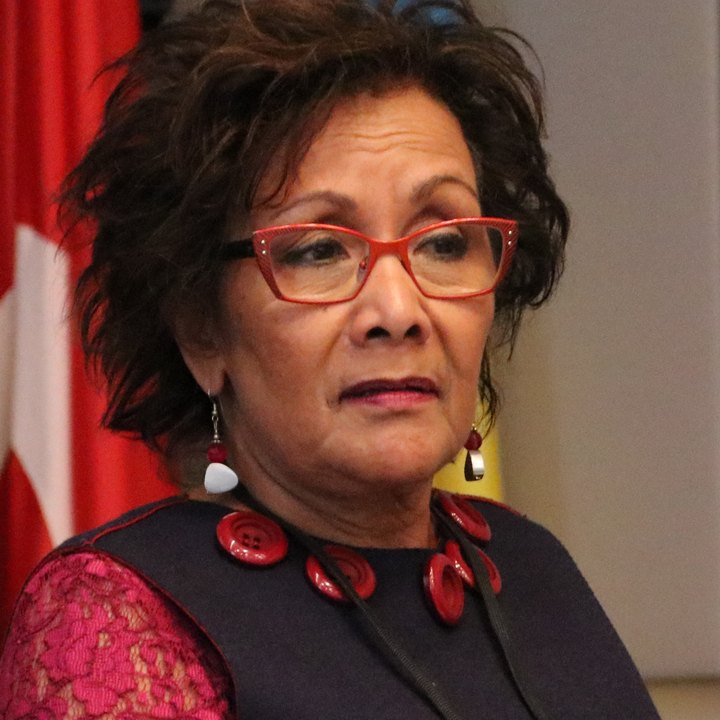
Hedy Fry
Liberal · Vancouver Centre, BC
Photo: OSCE Parliamentary Assembly from Copenhagen, Denmark, CC BY-SA 2.0, via Wikimedia Commons
Loading the riding.
Biography
Hedy Madeleine Fry is a Canadian politician and physician who has been the member of Parliament (MP) for Vancouver Centre since 1993. A member of the Liberal Party, Fry is the longest-serving female MP, having won eleven consecutive elections since 1993, when she defeated then Prime Minister Kim Campbell. encyclopedia
- Born
- 1941-08-06, San Fernandoencyclopedia
- Languages
- Englishofficial
- Occupation before politics
- physician, politicianencyclopedia
Electoral history
Vancouver Centre
Liberal · 45th ParliamentSince 2025-04-28officialHedy Fry29,855Elaine AllanRunner-up · Conservative16,368Difference 13,487 votes. 4 other candidates also ran.
Elections Canada, 45th general election.
Vancouver Centre
Liberal · 44th Parliament2021-09-20 to 2025-04-27encyclopediaHedy Fry20,873Breen OuelletteRunner-up · NDP-New Democratic Party15,869Difference 5,004 votes. 3 other candidates also ran.
Elections Canada, 44th general election.
Vancouver Centre
Liberal · 43rd Parliament2019-10-21 to 2021-09-19encyclopediaHedy Fry23,599Breen OuelletteRunner-up · NDP-New Democratic Party13,280Difference 10,319 votes. 6 other candidates also ran.
Elections Canada, 43rd general election.
Vancouver Centre
Liberal · 42nd Parliament2015-10-19 to 2019-10-19encyclopediaHedy Fry32,554Constance BarnesRunner-up · NDP-New Democratic Party11,618Difference 20,936 votes. 4 other candidates also ran.
Elections Canada, 42nd general election.
Vancouver Centre
Liberal · 41st Parliament2011-05-02 to 2015-10-18encyclopediaHedy Fry18,260Karen ShillingtonRunner-up · NDP-New Democratic Party15,325Difference 2,935 votes. 6 other candidates also ran.
Elections Canada, 41st general election.
Vancouver Centre
Liberal · 40th Parliament2008-10-14 to 2011-05-01encyclopediaHedy Fry19,506Lorne MayencourtRunner-up · Conservative14,188Difference 5,318 votes. 4 other candidates also ran.
Elections Canada, 40th general election.
Vancouver Centre
Liberal · 39th Parliament2006-01-23 to 2008-10-13encyclopediaHedy Fry25,013Svend RobinsonRunner-up · N.D.P.16,374Difference 8,639 votes. 5 other candidates also ran.
Elections Canada, 39th general election.
Vancouver Centre
Liberal · 38th Parliament2004-06-28 to 2006-01-22encyclopediaHedy Fry21,280Kennedy StewartRunner-up · N.D.P.17,050Difference 4,230 votes. 6 other candidates also ran.
Elections Canada, 38th general election.
Vancouver Centre
Liberal · 37th Parliament2000-11-27 to 2004-06-27Votes were not matched on the official file we have.
encyclopediaVancouver Centre
Liberal · 36th Parliament1997-06-02 to 2000-11-26Votes were not matched on the official file we have.
encyclopediaVancouver Centre
Liberal · 35th Parliament1993-10-25 to 1997-06-01Votes were not matched on the official file we have.
encyclopedia
Education
- University of OxfordDegree not recordedYears not recordedencyclopedia
Experience
Our sources do not list any previous employment for this member.
In their own words
16,124 Hansard interventions on file. These are the words said in the House, not a summary. Private conversations are not collected and are not invented.
I call this meeting to order. Welcome to meeting number 43 of the Standing Committee on Fisheries and Oceans. I would like to begin by acknowledging that we are gathered on the unceded territory of the Algonquin Anishinabe people. Pursuant to Standing Order 108, the committee…Debate · 2026-06-10
Where they stand
Policy positions are scored only from this member's stored House words and, when it is on file, their own public website. Wikipedia and other encyclopedias may supply details such as a birth date, education or work history, and each of those details is labelled with its source, but they are never used to score a position. Members whose only sources are encyclopedias have no scored positions.
A stored score on 13 of 14 topics. Each row names the end of that topic’s axis the stored words reached, and the sentence the score rests on.
Agriculture
Liberalize supply management
The other end of this axis: Defend supply management
Excerpt repeats support for cutting subsidies to farms so sectors sustain themselves competitively.
We did this by getting out of mega projects, by cutting back on subsidies to businesses, to farms, to transportation and to mining. We feel that these sectors can sustain themselves and be competitive if we just get out of their way. They have told us this often enough and now we are doing it.Source of that line
Climate
Faster fossil phase-down
The other end of this axis: Slower phase-down, production first
Supports Kyoto protocol and decreasing emissions by 20%.
The Canadian Medical Association has recently reiterated its clear support for the Kyoto protocol and for decreasing greenhouse gas emissions by 20%. This resolution was made in 1997 by the CMA.Source of that line
Defence
Higher spending and more capability
The other end of this axis: Restrain spending and deployments
Mentions investment to build defence capacity at scale.
This initiative will create direct, paid pathways for young Canadians to contribute to building housing, infrastructure, and defence capacity at the scale and speed required. To support this effort, the government is investing $2 billion to help young people enter the skilled trades, providing up to $10,000 in apprenticeship supports for employers, particularly small and medium-sized businesses, and making education more affordable by extending enhanced Canada Student Grants and interest-free Canada Student Loans for the 2026–2027 academic year.Source of that line
Energy
Restrict new oil and gas
The other end of this axis: Expand production and export
Supports Kyoto protocol and decreasing emissions by 20%.
The Canadian Medical Association has recently reiterated its clear support for the Kyoto protocol and for decreasing greenhouse gas emissions by 20%. This resolution was made in 1997 by the CMA.Source of that line
Federalism
Provinces lead
The other end of this axis: Ottawa leads
Excerpt states new era of federalism giving provinces greater flexibility and leverage.
It clearly marks the beginning of a new era of federalism and of federal-provincial relations. It is a move in the direction of a leaner, more efficient, more accountable system which recognizes provincial responsibilities and the ability to redesign and redeliver effective services at the local level; the bottom up approach that the opposition parties so often tout but are reluctant to implement.Source of that line
Fiscal policy
Lower taxes and tighter spending
The other end of this axis: Higher taxes and public spending
Supports deficit reduction, downsizing government and fiscal prudence, repeats tight spending.
I would like to stress that this budget has fulfilled all the promises made by our government. It was tough but it was fair. This budget has ensured that the financial burdens faced by all Canadians will be distributed in an equitable manner.Source of that line
Foreign affairs
Assertive alliances and sanctions
The other end of this axis: Alliance restraint
Supports rules-based order, sanctions and Ukraine aid, repeats assertive stance.
It is so far away up there in Eastern Europe, why are we bothered? We are bothered because this is not just about us. It is not just about Ukraine. It is not just about NATO. It is not just about Europe.Source of that line
Health
Expand public coverage
The other end of this axis: More private delivery
Opposes private clinics and cites US model as negative; supports public medicare principles.
What is wrong with setting up private clinics so that people who want to pay can pay? We only have to look at the United States where people who want to pay can pay and buy as much as they want whether or not they need it and people who cannot afford it have inadequate and inappropriate access to health care. A major determinant of health is socioeconomic status.Source of that line
Housing
Public supply and demand controls
The other end of this axis: Market supply and deregulation
Supports CMHC public mortgage insurance and social housing expenditures.
The federal government is very much concerned with the shelter needs of low income Canadians. The federal government is making considerable ongoing social housing expenditures of about $2 billion a year to support more than 661,000 needy households, notwithstanding the need for considerable fiscal restraint and the need for deficit reduction.Source of that line
Immigration
Higher permanent intake
The other end of this axis: Lower intake
Supports increasing family class numbers and expanding eligibility.
From 1998 to 2001 the family class in Canada moved from 50,882 to 66,713. That represents an increase of almost 16,000 immigrants only in the family class in just four years. However we felt this was not enough so the government introduced new regulations in 2002 to allow even more individuals to sponsor family members and to speed up the processing of family class applications.Source of that line
Labour
Stronger unions and standards
The other end of this axis: More flexibility for employers
Supports Bill C-64 to put teeth in commitment to equality.
I want to place Bill C-64 in that same international context. I want to look at our international obligations and how Bill C-64 will help us meet them. I want to consider some relevant international experiences with employment equity. I want to show the bill puts teeth in our commitment to equality and shows a leadership badly needed around the world. First I will discuss recent landmarks in understanding this issue.Source of that line
Public safety
Prevention and restraint
The other end of this axis: Enforcement and sentencing
Supports firearms act for prevention of suicides and domestic violence.
Firearms cause suicide. Some 1,100 suicides a year are committed with guns, which means that 78 per cent of firearm deaths are suicides. In 1990, 300 of the suicides were committed by 15 to 25-year-old youths. People who commit suicide with a gun have a 92 per cent success rate, compared with only 35 per cent if other means are used. As a physician and a mother this is totally unacceptable to me. It is alarming and it is sad.Source of that line
Trade
Diversify away from one partner
The other end of this axis: Deeper continental integration
Supports Team Canada missions and new trade relationships beyond traditional partners, repeats diversification.
As we advance trade and believe we cannot be friends with our neighbour anymore or trust our neighbour to help us out, we are looking at diversifying trade. Our Prime Minister has been to Asia and has built strong trade relationships with Japan and China. He is looking at India, and he just signed a deal with Indonesia.Source of that line
1 topics with no stored score
- Financial regulationNo position has been scored.
Who lines up
Comparing stored scores on the same questions.